
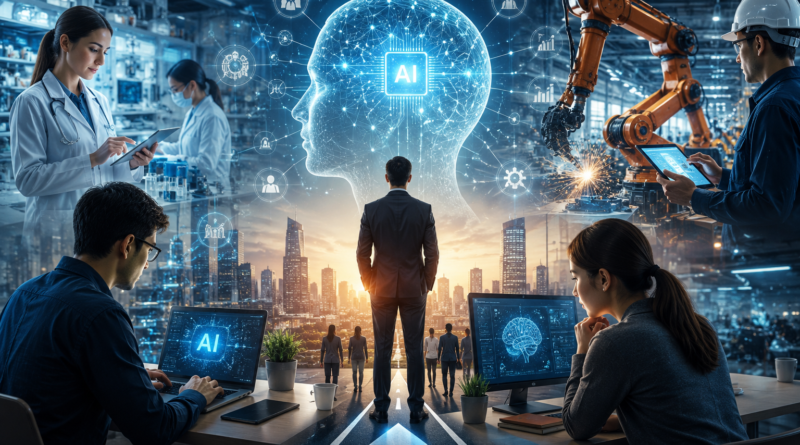
The Impact of Artificial Intelligence (AI) on Future Careers
Artificial Intelligence (AI) is changing the job market, creating new types of jobs while automating routine tasks. With 20-50 million new jobs expected by 2030, AI is creating and enhancing jobs in healthcare, pharmaceuticals, and other industries.
While some industries may experience significant job displacement, the economy is expected to benefit from increased productivity and output. As AI continues to evolve, understanding its impact on employment and the economy is crucial.
AI is rapidly transforming the workforce, with significant changes already apparent in the job market and employment landscape. As AI continues to develop and evolve, businesses and workers must adapt to stay competitive and efficient. The rise of automation and AI is transforming the workplace, impacting job roles across various industries, including high-tech manufacturing. Thanks to advanced technologies, many manual and repetitive tasks can now be automated, leading to increased efficiency and productivity.
But this shift is also causing job roles to evolve, with some becoming obsolete while new ones emerge. For example, manufacturing workers need to acquire new skills to operate and maintain machines and robots that are taking over manual tasks. Additionally, AI integration into high-tech manufacturing processes is creating new job roles like data analysts, AI programmers, and machine learning specialists.
These emerging job roles require a combination of technical skills and a deep understanding of business processes. The jobs of the future will require a mix of technical skills, creativity, and adaptability to leverage the power of automation and AI effectively.
As AI continues to transform the job market and employment landscape, individuals need to adapt to stay relevant and competitive in their careers. One way to adapt is to focus on developing skills that are in high demand, such as data analytics, machine learning, and programming. This can involve taking courses, attending workshops, or earning certificates in these fields. Another way to adapt is to embrace the opportunities presented by AI, such as using it to augment human capabilities and work more efficiently. This may involve learning how to work with AI tools and technologies and collaborating with AI systems to achieve better results.
Additionally, individuals should stay informed about the latest developments in AI and its impact on their industries. This can involve following industry publications, attending conferences, and networking with peers and experts.
Finally, individuals should remain flexible and adaptable, as the job market and employment landscape continue to evolve rapidly in response to AI and other technological advances. By embracing change and continually developing their skills and knowledge, individuals can thrive in a world where AI is transforming the way we work.
Conclusion
Artificial Intelligence is rapidly transforming the future of careers by creating new opportunities while changing the nature of existing jobs. As automation continues to expand across industries, success will increasingly depend on continuous learning, digital literacy, adaptability, and the ability to work alongside AI technologies. Rather than viewing AI as a replacement for human workers, individuals should see it as a tool that enhances productivity and innovation. The information presented in this article is based on insights and findings from reputable organizations, including the World Economic Forum (WEF), McKinsey & Company, the International Labour Organization (ILO), and the Organisation for Economic Co-operation and Development (OECD), all of which highlight the growing importance of AI-driven skills and workforce transformation. By embracing lifelong learning and staying informed about technological advancements, students and professionals can prepare themselves for a successful future in an AI-powered world.
World Economic Forum – Future of Jobs Report 2025
Future of Jobs Report 2025
(Full report PDF: Download PDF)
World Economic Forum – 170 Million New Jobs by 2030
Future of Jobs Report 2025 Press Release
McKinsey & Company – AI in the Workplace (2025)
Superagency in the Workplace: Empowering People to Unlock AI’s Full Potential at Work
International Labour Organization – Generative AI and Jobs
Generative AI and Jobs: A Refined Global Index of Occupational Exposure
Organisation for Economic Co-operation and Development – Future of Work
OECD Future of Work