
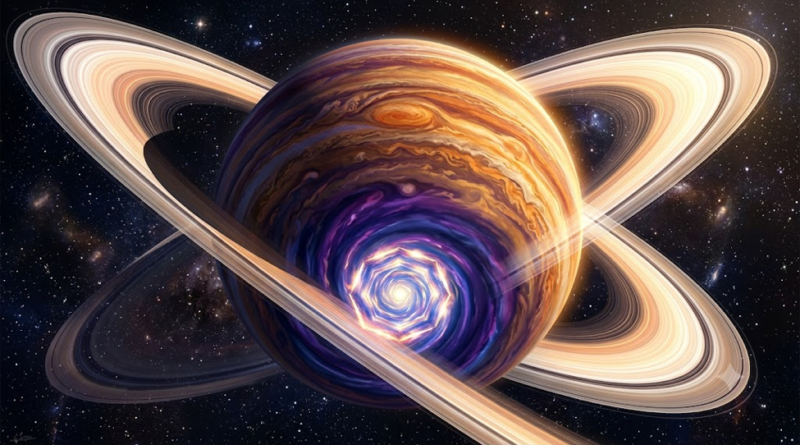
The Saturn Decagon: Unlocking the Mystery of Saturn’s South Pole Storm
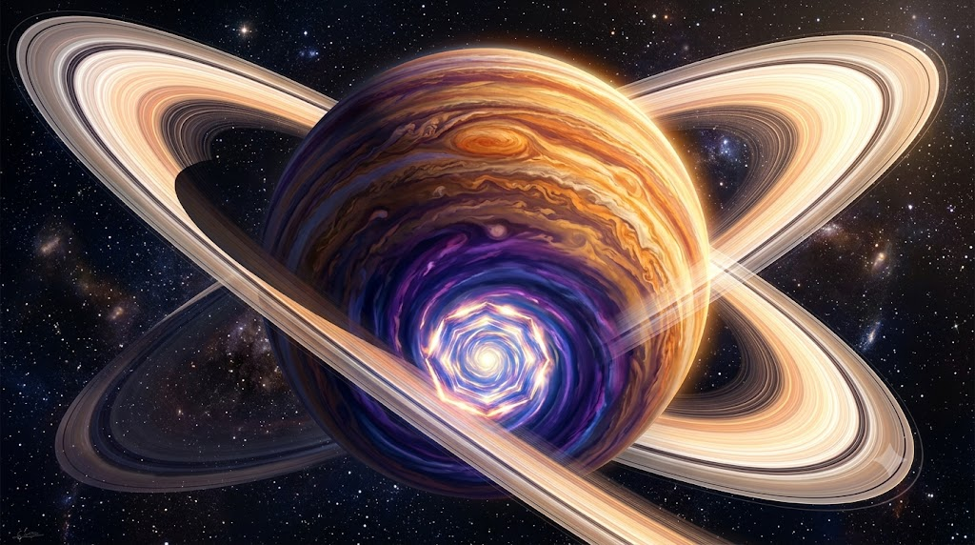
For over four decades, planetary scientists believed that Saturn’s famous northern hexagon was a unique, isolated marvel of fluid dynamics. First glimpsed by the Voyager spacecraft and later imaged in high resolution by the Cassini probe, the northern six-sided jet stream appeared to be the solar system’s only perfectly geometric weather pattern. However, groundbreaking astronomical observations have radically reshaped our understanding of the ringed planet. High-resolution images from the NASA Hubble Space Telescope, supported by ground-based observatories and amateur astronomers, have revealed a massive, ten-sided atmospheric structure surrounding the south pole: the Saturn decagon.
This newly identified polar pattern consists of an immense, ten-sided wave embedded directly within a high-speed eastward jet stream. Sitting at roughly 60 degrees south latitude, each side of this cosmic polygon spans thousands of miles, circling a turbulent polar region. While the underlying jet stream hurtles around the gas giant at speeds exceeding 250 miles per hour, the decagon structure drifts at a far more modest pace of roughly 6 miles per hour. Multi-wavelength observations indicate that the wave extends vertically across multiple atmospheric cloud layers, proving that it is not merely a superficial haze, but a deep-seated atmospheric phenomenon.
The sudden appearance of the decagon provides scientists with an unprecedented opportunity to watch a giant planetary wave form and evolve in real time. Historical data from the Cassini mission, which mapped Saturn until 2017, showed no evidence of a ten-sided pattern in the southern hemisphere, suggesting the feature emerged relatively recently. Planetary scientists hypothesize that the wave is generated by deep thermal convection, shearing winds, and interactions with nearby vortices, including a high-pressure anticyclone operating in the southern mid-latitudes. To explore more detailed technical papers and mission archives on planetary atmospheres, visit the NASA Jet Propulsion Laboratory for extensive solar system research.
Understanding how these geometric patterns form expands our knowledge of fluid dynamics, meteorology, and gas giant behavior. Lab experiments on Earth using rotating tanks of fluid have demonstrated that standing polygonal waves can form spontaneously when fluid speeds and density gradients hit specific thresholds. By comparing the long-lived, highly stable northern hexagon to the dynamic, developing southern decagon, researchers are refining mathematical models of atmospheric flow. You can learn more about how planetary weather patterns compare across the outer planets by reading our detailed guide on internal planetary dynamics and gas giant meteorology.
As Saturn continues its orbit and seasonal light shifts across both hemispheres, astronomers will rely on the Hubble Space Telescope and the James Webb Space Telescope to monitor how long the decagon persists. Whether this ten-sided storm stabilizes for decades like its northern counterpart or dissipates back into chaotic atmospheric turbulent flow remains an open question. For ongoing mission updates, images, and observational data regarding deep-space discoveries, check the European Space Agency Space Science portal. The discovery of the Saturn decagon fundamentally proves that geometric atmospheric structures are a natural feature of planetary physics, opening a fascinating new chapter in planetary exploration.