
IIT Guwahati Study Uncovers How Plants Adapt to Drought, Offering Hope for Climate-Resilient Agriculture
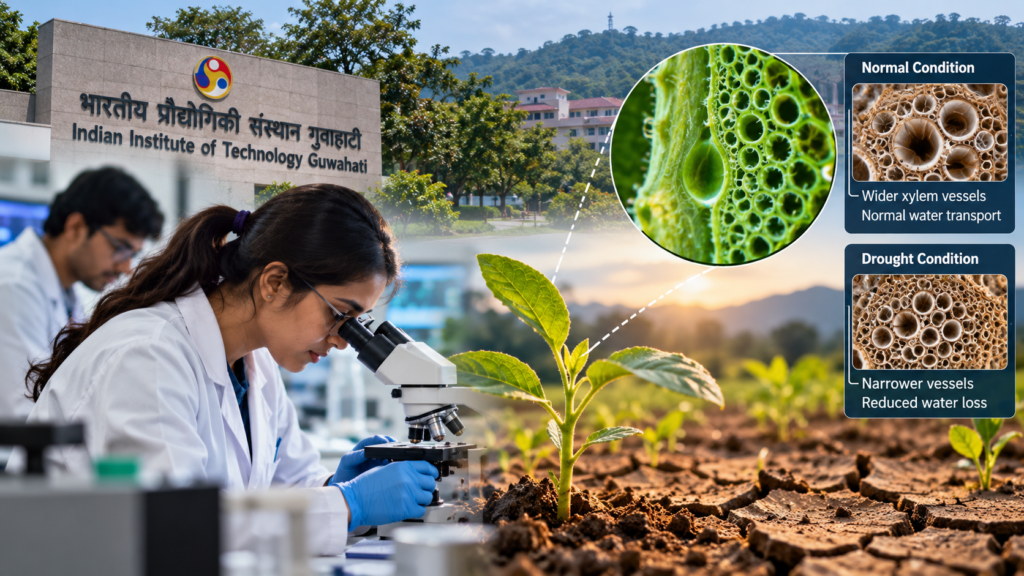
Guwahati, October 26, 2026: Researchers at the Indian Institute of Technology (IIT) Guwahati have investigated how plants modify their internal water transport systems when faced with drought. The findings could help scientists better understand plant survival during water shortages and contribute to the development of drought-tolerant crops.
The research, led by Professor Pranab Kumar Mondal of IIT Guwahati’s Department of Mechanical Engineering, combines experimental measurements with three-dimensional computer simulations to examine how water moves through plants under stress. The findings have been published in the journal Applied Physics Reviews.
The study is particularly relevant as changing climatic conditions and water scarcity continue to pose challenges for agricultural productivity in several parts of the world.
How Do Plants Survive Water Shortages?
Plants depend on a network of microscopic tubes known as xylem to transport water from their roots to their leaves. These vessels are connected through tiny openings called pits, which help regulate the movement of water within the plant.
Under normal conditions, this network supports essential processes such as growth, nutrient transport and photosynthesis. However, when water becomes scarce, plants must adjust their internal systems to manage the limited supply.
Earlier computational models often treated xylem vessels as rigid pipes, making it difficult to capture the structural changes that occur during drought.
The IIT Guwahati team addressed this limitation by studying how drought affects the dimensions, mechanical properties and elasticity of xylem vessels, along with the size of their connecting pits.
What Did the Researchers Discover?
The researchers studied Indian mustard plants (Brassica juncea) using advanced imaging, microscopic force measurements and chemical tracking. These observations were then incorporated into realistic three-dimensional computer models.
The study identified several changes associated with severe water stress:
- Narrower water-conducting vessels: The xylem tubes become narrower, increasing resistance to water movement.
- Smaller connecting pits: The tiny openings between vessels also shrink, affecting the movement of water through the network.
- Changes in water movement: The researchers found that lateral, or sideways, water transport through the pits becomes important in maintaining water balance within the plant.
These structural adjustments restrict the upward movement of water and can help reduce water loss through transpiration. They also provide insight into how plants regulate their internal transport networks under challenging environmental conditions.
The findings help explain the relationship between a plant’s microscopic structure and its ability to respond to drought. <escape>[Source: India Today NE]</escape>
Why Is This Research Important for Indian Agriculture?
Agriculture depends heavily on reliable water availability. When rainfall is insufficient or irrigation supplies are limited, crops can experience stress that affects their growth, development and productivity.
Understanding how plants respond to drought at the microscopic level could help researchers identify characteristics associated with better water management.
In the future, these insights may support the development of crop varieties that can tolerate water shortages or use available water more efficiently.
For farmers, improved drought resilience could eventually mean lower risks of crop losses during periods of insufficient rainfall. However, translating laboratory findings and computer simulations into practical agricultural benefits will require further research and testing.
The study does not itself establish that a new drought-resistant crop has been developed. Instead, it offers a scientific framework that could inform future crop research and breeding programmes.
The Role of Technology in Understanding Plant Biology
One notable aspect of the research is its combination of experimental science and computational modelling.
By measuring the physical properties of plant tissues and incorporating those measurements into three-dimensional simulations, researchers can investigate processes that are difficult to observe directly inside living plants.
This approach also demonstrates how engineering principles can contribute to biological research. Fluid mechanics, material properties and computer simulations can help scientists understand how living systems respond to environmental pressure.
For IIT Guwahati, the research highlights the potential of interdisciplinary collaboration to address problems connected to agriculture, climate adaptation and sustainable resource use.
Could This Help Farmers in Northeast India?
The findings may be relevant to agricultural research in Northeast India, where farming systems vary considerably across the region. Although parts of the Northeast receive substantial rainfall, water availability is not uniform throughout the year, and some areas experience dry spells or seasonal water stress.
Research into drought responses could eventually contribute to efforts to improve crop resilience under different environmental conditions.
Nevertheless, the study focused on Indian mustard plants. Its findings should not automatically be assumed to apply equally to rice, tea or every crop grown across Assam and neighbouring states. Additional studies would be needed to determine how these mechanisms operate across different plant species and agricultural environments.
What Happens Next?
The next challenge is to translate a better understanding of plant water transport into practical agricultural applications.
Researchers will need to establish which structural characteristics are most useful for crop improvement, how these traits vary across plant varieties, and whether they can be incorporated into breeding programmes without compromising growth or yield.
Further field testing would also be needed to assess performance under real agricultural conditions.
If future research builds successfully on these findings, a better understanding of plant water transport could become one part of a broader effort to develop more climate-resilient farming systems.
Conclusion
The IIT Guwahati study provides new insight into how plants modify their internal water transport networks under drought stress. By combining physical measurements with advanced computer simulations, the researchers have offered a clearer picture of how microscopic structural changes influence water movement.
While practical applications remain a future possibility rather than an immediate outcome, the findings could help guide research into drought-tolerant crops and more efficient agricultural water use.
As climate variability places increasing pressure on food production, understanding how plants respond to water scarcity may become an important part of building more resilient agricultural systems.
Source: Reporting by India Today NE and The News Mill, published on October 26, 2026. The research was published in Applied Physics Reviews.