
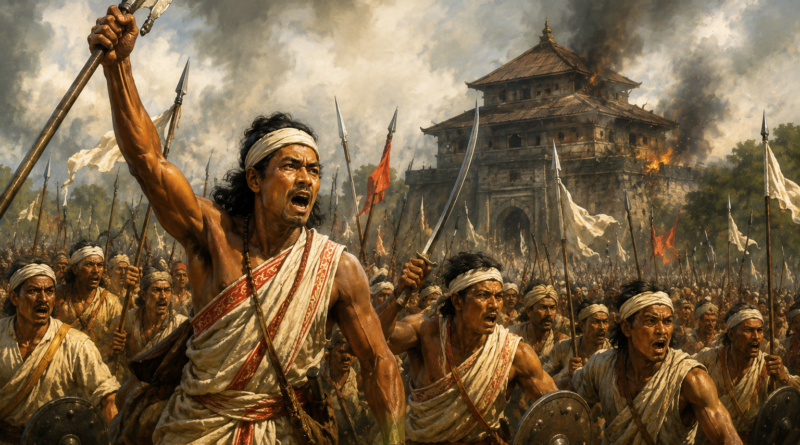
Rise of the Moamoria Rebellion
By Dr. Neha Boruah
Introduction:
Moamaria, Mayamara or Matak or Moran – these terminologies are often used synonymously in various contexts. The Mataks are probably best known in Assam’s history for the Moamaria revolt that put an end to Ahom dynastic rule and paved the way for British colonial rule. Led by the Morans of Upper Assam and architected by Mayamara Mahanta, the Moamaria revolt drew support from all kinds of disciples of the Mayamara sattra. They were also joined by various other tribal groups, oppressed and exploited sections by the ruling class through the paik and khel system. The Moamaria revolt was instrumental in creating an autonomous territory, Matak Rajya (Matak State), with present-day Tinsukia (then known as Bengmora) as capital under the headship of Sarbananda Singha. The Moamoria rebellion (1769–1805) was an 18th-century uprising in the Ahom kingdom of present-day Assam that began as a power struggle between the Moamorias (Mataks), the adherents of the Vaishnavite Mayamara Satra, and the Ahom kings. It was a powerful social, religious, and political uprising that shook the very foundations of the Ahom Kingdom.
According to Historians:
Historian D. Nath (2008) points out that, “there is no doubt that the name Mayamara was thus created to erase the name Moamara, which was not only ridiculous but was also one of contempt towards a supposedly heretic religious community. The discovery of a myth to defend the sect from being ridiculed is a clear example to show that there was an element of continued dislike of the Mayamara pontiffs against the orthodox Brahmanical section of the society represented by the other samhatis. The distinction is clearly recorded in the Tungkhungiya Buranji by mentioning the two factions as Moamariya and Bamuniya. (Nath, 2008)
Background of the Study Area:
- The Moamoria Paiks led the rebellion against the Ahom empire.
- The Moamarias were followers of the Moamaria sattra, which was primarily Morans (the mainstay of the Ahom militiary) but there were also Sonowal Kacharis (gold-washers), Chutias (expert archers and matchlock men), professional castes such as Horas (potters), Kaibartas (fishermen), Bania (artisans), and Ahom nobles and officers.
- The expanding popularity of Moamaria sattra had drained the strength of orthodox Hindu organisations and the Shakti cult, which had backed the Ahom rulers.
- The sattras were a haven for anyone trying to flee the Paik system, which allowed any able-bodied person who was not a Brahmin or a noble to be exploited for labour, services, or recruited into the army.
- The Ahom kingdom was in trouble because the Paik system, on which the state was founded, was unable to adjust to the changing economy and developing social strata.
- The growth of the sattras was one of the causes of the Paik system’s loss of manpower, and as a result, the Ahom monarchy and the sattras came into growing conflict.
Result and Discussion:
For more than three decades, it exposed deep cracks in the system and changed the course of Assam’s history forever. This rebellion was a struggle of the oppressed against the powerful, wherepeasants, tribal groups, and religious reformers rose against the ruling elite. The Moamaria revolt of 1769 was a powerful challenge to the authority of Assam’s Ahom monarchs. The Moamoria insurrection began as a power struggle between the Moamarias (Matkas), devotees of the Moamara Sattra, and the Ahom rulers in the 18th century in the Ahom kingdom of present-day Assam. This battle expanded across the Ahom kingdom, including disaffected parts of the Ahom elite, resulting in the Ahom monarch losing control of the capital. According to Mackanzie (1884) The Moamariahs were a tribe of proselytes to Hinduism as preached by the Sudras sectarians, Sankni and Madhit, who denied the supremacy of Brahmans and rejected the worship of Siva.
Religious Tensions and Discrimination
The Moamorias were followers of a liberal Vaishnavite sect, which believed in:
- Equality among people
- Rejection of strict caste hierarchy
- Simpler forms of worship
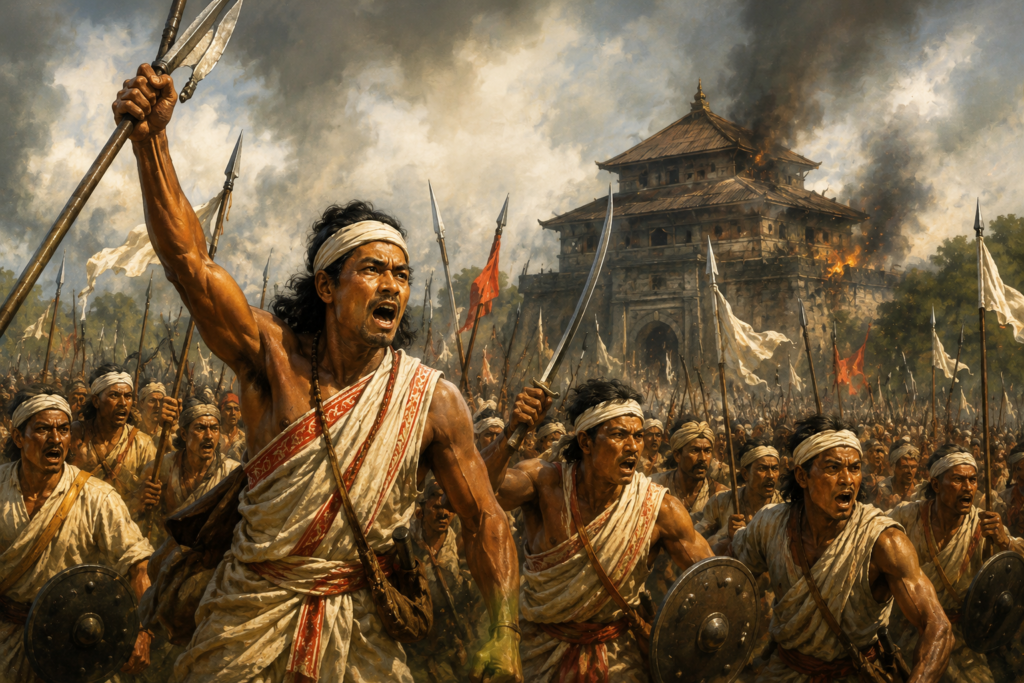
The term Moamaria holds a distinct and important place, and the famous Moamaria revolt was responsible for bringing down the 600-year-long dynastic rule of the Ahoms. In 1228, Sukaphaa, a prince of Mung-Mao or Mung-Mao-Lung in Yun-Nan province of China with approximately 9000 people, crossed the Patkai hills and reached the Brahmaputra valley. Sukaphaa did not attack the local Morans and Borahis; instead, he established friendship with them, and the followers who travelled with him established marital alliances with Morans and Borahis. Finally, Sukaphaa settled in Charaideo, a place near Sivasagar, and established his Ahom Kingdom. The Moamoria revolt, which started in 1769 against the state, weakened the structure of the state economically and politically. The rebels attacked the Ahom capital and were in seat for a short period. However, the Ahoms recaptured the capital from the rebels. between 1817 and 1826, during which the Ahom Kingdom briefly came under the control of Burmese rulers. In an attempt to reclaim his lost kingdom, the Ahom king sought help from the British, who sent a force to fight the Burmese Army. The First Anglo-Burmese War was fought in 1826, and the British forces won the war and gained control over the region. It is the Treaty of Yandaboo, signed in 1826, through which the Ahom Kingdom was annexed to British India. The sect started by Aniruddhadev (1553-1626) under Kala samhati of Neo-vaishnavism is called the Mayamara Sect. It is said that Aniruddhadev first preached his doctrines among the members of the fisherman community living on the bank of a lake where a small variety of fish called Moa (Indian carplet) was found. People of this community used to kill or catch (mara) the Moa fish and subsisted on this. The sect started by Aniruddhadev (1553-1626) under Kala samhati of Neo-vaishnavism is called the Mayamara Sect. It is said that Aniruddhadev first preached his doctrines among the members of the fisherman community living on the bank of a lake where a small variety of fish called Moa (Indian carplet) was found. People of this community used to kill or catch (mara) the Moa fish and subsisted on this. The sect started by Aniruddhadev (1553-1626) under Kala samhati of Neo-vaishnavism is called the Mayamara Sect. It is said that Aniruddhadev first preached his doctrines among the members of the fisherman community living on the bank of a lake where a small variety of fish called Moa (Indian carplet) was found. People of this community used to kill or catch (mara) the Moa fish and subsisted on this. The Moamaria revolt started in 1769 AD. In 1769, Ragh Neog, a Moran leader was flogged by the royal official Kirtichandra Borbarua. The Morans, under the leadership of Ragha Neog and Naharkhora Saikia, launched their revolt against the ruling class. The ‘Moran revolt’, as termed by some historians, swelled into various parts of upper Assam in no time. They were immediately joined by the people from various castes, tribes, and communities. With the help of the ordinary paiks17, the rebels captured Rongpur, the Ahom capital, in November, 1769. But, the royal force successfully dominated the revolt and reclaimed the The second phase of the Moamaria revolt started in 1782 AD.
Between 1786 and 1794, the rebels again started the revolt. This was the third phase of the Moamaria revolt. The rebels organised themselves through festivals, kirtanas and other religious occasions, and attacked the capital city of Rongpur. They captured the capital and a large part of the eastern Ahom Kingdom. The success of rebel forces encouraged many others from different communities, such as Bodos19 and Kacharies, to also join the rebels. The Ahom king and royal officers decided to seek the help of the British. Upon their request, the British Governor General Cornwallis sent a force under Capt. Welsh in September 1792. This force overwhelmed the Moamaria forces and recaptured the capital Rongpur in March, 1794. Subsequently, the Ahom royal capital was shifted to Jorhat as Rongpur seemed very vulnerable to the repeated Moamaria attack. The strategic intervention of the British forces, the Moamoria revolt of the commoners, was put to an abrupt end. However, in 1805, an autonomous territory was carved out for Morans, called Matak Rajya in the Tinsukia region of the Ahom Kingdom, with Sarbananda Signha as chief or Borsenapati. The Moamaria revolt had a tremendous impact on the future of the Ahom dynasty, as well as the political future of the entire Assam region. Sir E. A. Gait, although emphasising the distinctiveness of the three terms Moran, Matak and Moamaria, presented a view of their meaning which is contrastive to the popular belief. He wrote, “The terms Moran, Matak and Moamaria are often used indiscriminately, but they are quite distinct. Moran is the name of a tribe and Mayamaria that sect, while Matak refers to the country once ruled by the Bar-Senapati. In April, at the time of Bohag Bihu, the springtime festival of Assam, an armed group of the Moamaria rebels suddenly attacked a convoy of the Ahom king. The king, however, managed to escape. The rebels entered the capital and captured several important royal officials. “The second Moamaria revolt demonstrated that without the active and extensive support of the masses, it is not possible to stage a successful upsurge against the ruling class capital
It may be argued that the socio-religious or socio-economic reasons were alone not responsible for the Moamaria revolt. No doubt that the displeasure of Mayamara sattras towards the Ahom rulers for patronizing Brahminical Sect and continual oppression of the followers of those sattras ignited the commoners and worked as a launchpad for the revolt. The feudal paik system exploiting the labourers was a reason enough to raise a revolt against the ruling class as well. These multiple reasons together, influencing each other internally, could provide a glimpse into the way commoners’ anguish was expressed through Moamaria revolt, also complicating it for a historian to analyze and arrive at a conclusion.
Conclusion
The Moamaria Revolt occupies a significant place in the history of Assam as one of the earliest and longest popular uprisings against an established ruling power. Although it originated within the Mayamara sect of Neo-Vaishnavism, the movement gradually transformed into a widespread socio-political and economic revolt that reflected the deep-rooted grievances of the common people. The liberal ideals of the Mayamara sect, which emphasized equality, simplicity in worship, and rejection of rigid caste distinctions, came into direct conflict with the Ahom rulers’ support for Brahmanical orthodoxy and their discriminatory treatment of the sect’s followers. This religious exclusion created resentment among the Morans, Mataks, and other marginalized communities, who became the backbone of the rebellion.
The exploitative paik system, excessive taxation, forced labour, administrative corruption, social discrimination, and political instability collectively contributed to widespread public dissatisfaction. These interconnected factors transformed the movement into a mass uprising involving peasants, tribal communities, artisans, and other oppressed sections of society. The repeated phases of the revolt demonstrated not only the determination of the rebels but also the declining authority of the Ahom monarchy and its inability to address the concerns of its subjects.
The prolonged conflict severely weakened the administrative, military, and economic foundations of the Ahom Kingdom. Continuous warfare disrupted agricultural production, reduced state revenue, and undermined the legitimacy of the ruling dynasty. Although the Ahom rulers eventually regained control with the support of the British, the kingdom had already become politically fragile. This weakened condition made Assam vulnerable to the Burmese invasions and ultimately facilitated British intervention and annexation following the Treaty of Yandaboo in 1826.
Therefore, the Moamaria Revolt should not be viewed merely as a religious rebellion or a sectarian conflict. Rather, it was a multidimensional movement driven by religious discrimination, social inequality, economic exploitation, and political oppression. It exposed the structural weaknesses of the Ahom state and highlighted the growing aspirations of marginalised communities for justice, dignity, and equality. The revolt remains a landmark event in Assamese history because it marked the decline of the Ahom dynasty, reshaped the political landscape of the region, and demonstrated that sustained oppression can ultimately lead to organised resistance and significant historical transformation.